Friday, January 7, 2011

Christmas in Germany: Rothenburg ob der Tauber

We took the train from Würzburg through Steinach to Rothenburg ob der Tauber in the morning. It was just under an hour in transit. From the train station we walked about 700 meters through a normal bustling city toward the hotel.

And then, as traffic became less dense and the roads less well tended (there was a good six inches of snow on the ground), we rounded a corner and saw it. Imposing stone city walls, complete with towers and a wide stone gate. We were in Rothenburg ob der Tauber.


The name Rothenburg ob der Tauber means, in German, Red Fortress Above the Tauber [River]. The medieval Imperial Free City is situated on a plateau overlooking the Tauber river. Some of the foundations of the city date back to 950 AD.

To Nazi ideologists during WWII, Rothenburg was the epitome of the German town, symbolizing all that was quintessentially German. I can’t blame them. It seemed like the most German of all the German towns we visited. Throughout the 1930s the Nazis planned regular day trips to Rothenburg, to the pleasure of its citizens, who supported National Socialism.

In March 1945, German soldiers were stationed in Rothenburg to defend it. On March 31, bombs were dropped over Rothenburg by 16 planes, killing 39 people and destroying 306 houses, six public buildings, nine watchtowers, and over 2,000 feet of the wall. The US Assistant Secretary of War McCloy knew about the historic importance and beauty of Rothenburg; supposedly his mother had a painting of Rothenburg over her mantel. He ordered US Army General Devers not use artillery in taking Rothenburg. The local military commander Major Thömmes ignored the order of Adolf Hitler for all towns to fight to the end. He gave up the town, thereby saving it from total destruction. In other words, even enemies agreed that this was a special place, and both broke orders in its favor.


So many old cities promise that you can “step back in time” by walking their streets, but Rothenburg is one of the first where I have found that to be true. We could feel the history seeping from the half-timbered houses and the old stone wall.

We stopped at our hotel, Hotel Spitzweg. The house was originally a manor in 1536 and became a brewery in 1704. It became a hotel the year I was born. The proprietor, Walter, was a charming old man who took our small suitcases and sent us along to a restaurant, beaming.


We ate at Zum Ocsen. We were thrilled when the server asked us solicitously, “Was möchten-sie essen?” It was the exact phrase we had studied carefully: “What would you like to eat?” Michael ordered potatoes and pork loin, and I, using my handy German phrasebook, ordered meatloaf with potato salad. Much to my dismay, “meatloaf” was certainly a loaf of meat: it was some sort of barely cooked bologna. My vinegar potato salad, however, was divine. I made Michael trade meats with me and we ate our fill.

Bellies full, we wandered throughout the town until our legs got tired. We went into a little café, strengthened ourselves with wine, and then continued our wanderings through the fantastic town.


As we reached the Christmas market, it began to snow. Words cannot describe how magical Rothenburg is when it’s snowing.


At eight o’clock, we made our way to the town hall and met up with the Night Watchman. This guy was a trip. He had this squeaky, half-drunken way of telling stories about the history of the town, and even though it began to rain a few minutes into his tour, we stuck with him, shaking from the cold, until the bitter end.


We ducked out of the rain and into Hell—no, literally, we ate at Zur Höll, which means To Hell. The building dates back to circa 900 and is the second oldest in Rothenburg. I had amazing roast beef and Michael had the goose and dumplings. It was fabulous.


The next morning, we ate a traditional German spread—coffee, cold cuts, bread, and potatoes—at high speed because we wanted to catch the 9:10 train. Walter was sitting with other guests, chatting over their breakfast, but it was clear he intended to make his way to us in good time. When we stood to leave, he exclaimed, “You are finished?”

“Ja,” I told him. “It was very good. We just have a train to catch.”

He declared in his thick German accent, “That is the fastest breakfast I ever did see!”

We checked out. The rain from the night before had frozen into a thick coat of ice on the sidewalk, and Walter positively wrung his hands from the doorway, shouting advice on how to walk on the ice, as we trundled away. We hated to leave this picturesque city.

Saturday, January 1, 2011

Christmas in Germany: Würzburg

We spent Christmas in Germany, and what an amazing trip it was. It easily ranks as our best vacation—the memories, the sights, the food, the wine, and the snow… so much snow! We were in Germany for eleven days, not counting the two travel days.

We took trains from city to city and enjoyed looking out the window to spot a hare leaping through a snowy field, a brown-and-black deer stripping bark from a snow-mantled tree, or a white-winged hawk sailing along ten feet from the train (and keeping up). The trains were easy to figure out and prevented us from having to drive on icy roads.

Our first stop after getting off the plane in Frankfurt was to Würzburg. Würzburg is a city in the northern tip of Bavaria with main draws including the medieval Fortress Marienberg towering above the town and the sculpture-adorned Old Main Bridge. Unfortunately, Marienberg is closed October through March, so we only saw it from afar.


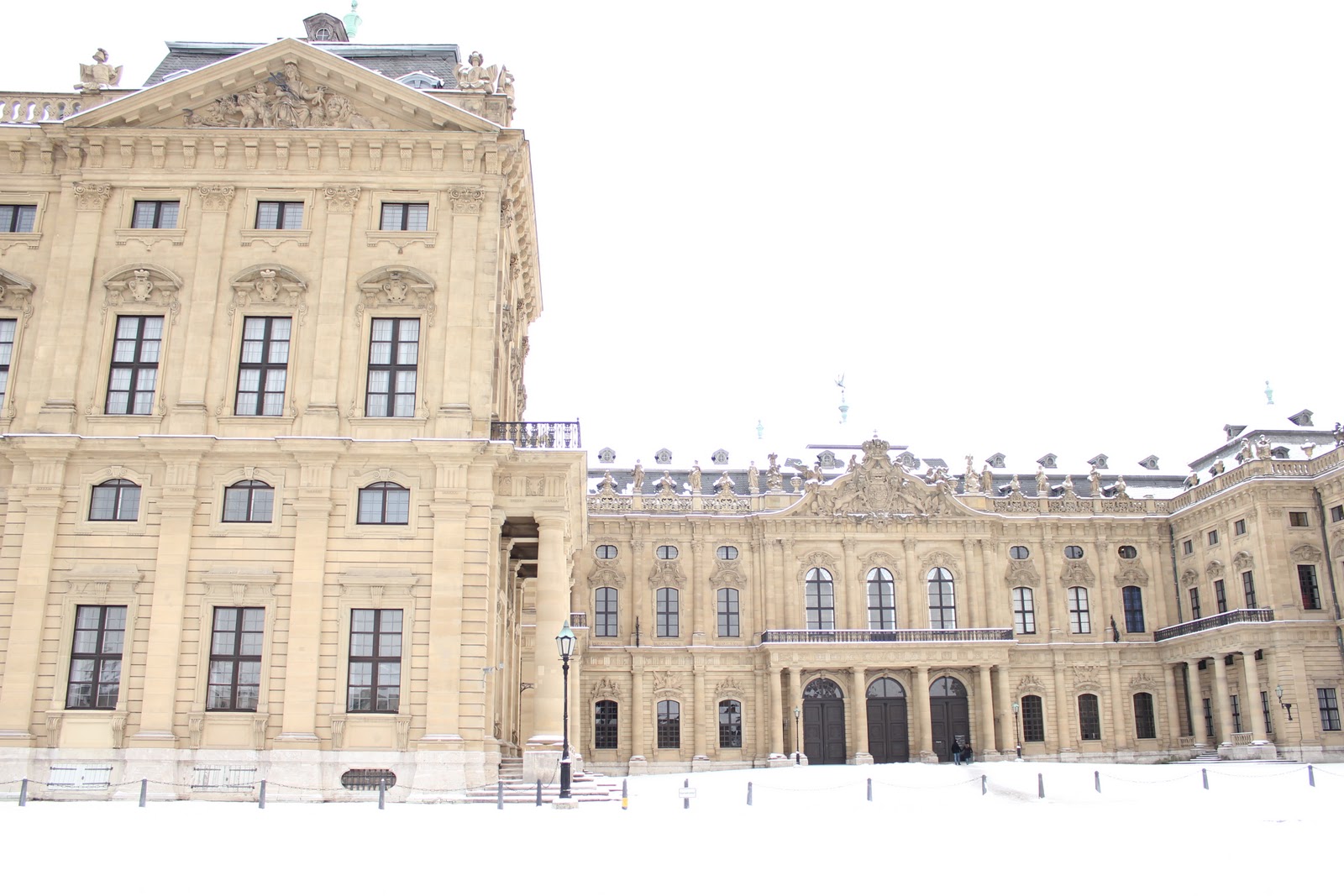
After settling into our hotel, Würzburger Hof, we made for the Prince Bishop’s Residence and enjoyed a tour of the palace, built in 1744. Although much of it was destroyed during WWII, it was completely rebuilt as it was before the war. No photos were allowed inside.


Afterward, we went to the Würzburg Christmas market. In Germany, each city erects small wooden buildings in town squares during Christmas where vendors can sell sausages, glühwein (a fantastic mulled wine which I have since made at home with great success), and other yummy treats; homemade goods; jewelry and clothing; decorations; and Christmas gifts of all colors and sizes.


We had dinner at Ratskeller, a historic Franconian wine restaurant with a long tradition. Michael ordered bratwurst with sauerkraut, and I ordered the lamb medallions with ratatouille. Everything was fantastic.

We made our way to a second Christmas market and enjoyed the contrasting architecture of a cathedral and a Christmas-light-adorned obelisk.


Jet lag was settling in, so we went back to the hotel and crashed after a brief walk through the stalls and a glühwein.

Saturday, December 11, 2010

Philadelphia: Edgar Allan Poe National Historic Site


Edgar Allan Poe lived in a house in Philadelphia for six years. He wrote some of his most famous work while living there, including my favorite Poe piece, “The Tell-Tale Heart,” as well as “The Pit and the Pendulum,” “The Black Cat,” “The Fall of the House of Usher,” “The Masque of the Red Death,” and “The Cask of Amontillado” among others. With him in Philadelphia lived With him lived his wife Virginia, his mother-in-law Maria Clemm (whom he called Muddy), and their cat, a tortoise-shell tabby named Catterina. It was here that he experienced some literary acclaim, though it was before “The Raven,” and the addiction and poverty to which he later succumbed weren’t yet at their peak in Philadelphia.

We visited the Edgar Allan Poe National Historic Site and immediately loved the gutted, empty feel of the house. There was no furniture, no wallpaper, nothing to indicate the literary giant had once resided here except a raven erected out front, long after he was gone. The place had a creepy feel even in broad daylight, with the boards creaking and the footsteps echoing in the vacant rooms. We particularly enjoyed the cellar, where spiderwebs abounded and dirt caked the floor. 


There were two possible signs of Poe. In one room, the word DEATH was scrawled into a wall. The ranger told us they weren’t sure if Poe had done it, or if squatters had done it long after Poe left. Also, green wallpaper had been recovered; the Park Service was pretty sure had been on the walls when Poe lived there.


You could almost feel the great author’s presence in the empty rooms, better by far than if they had been filled with replicas and fakes.

Thursday, December 9, 2010

Philadelphia: The Brandywine River, Valley Forge, and Chaddsford Winery

On Sunday morning, we both were under the weather, but we didn’t cancel our plans of an outdoorsy day. We left Philadelphia at 8:00 and arrived at Valley Forge National Park around 8:30. It was at Valley Forge that General George Washington forged the Continental Army in 1777. I have two ancestors, eight generations back, who were commissioned officers under Washington’s command, and it was neat to think I was stepping where they had stepped. It was a crisp autumn morning. We walked about two and a half miles along the paved walking trail, past replicas that put one in the mindset of the Revolutionary War. We saw dozens of deer and flocks of geese, and the fall foliage was lovely.


We grabbed some lunch at a market and arrived at Northbrook Canoe Company around noon. We rented a canoe and paddled almost five hours down the Brandywine River, where the clear water sparkled over golden zinc. A chilly breeze kept our jackets on for most of the trip, but the sky was a deep, clear blue and we had the river mostly to ourselves.


Near the end of our trip, we saw a juvenile bald eagle, its brown feathers rough. We were extremely excited and decided to grow quiet in case its family was nearby. As we gave up hope—and I put away the camera—we began to talk loudly and disturbed a hidden adult bald eagle in the trees just above our heads. She took off. Her wingspan was wider than I am tall, and her beautiful plumage shone in the midafternoon sun. Her wingbeats reverberated in the air. We both clapped our hands to our mouths and watched in awe as she soared within ten feet of us and out of sight. It was the most amazing thing that happened on the Philadelphia trip.

Bubbling with our experience and both feeling in peak health again, we drove to Chaddsford Winery, which was founded in 1982 and had live music playing on its patio. We tasted the semi-drys and sweets and bought a bottle for later. We then took the scenic route back to the hotel through yellow and orange foliage.