Monday, February 7, 2011

Christmas in Germany: Nuremberg

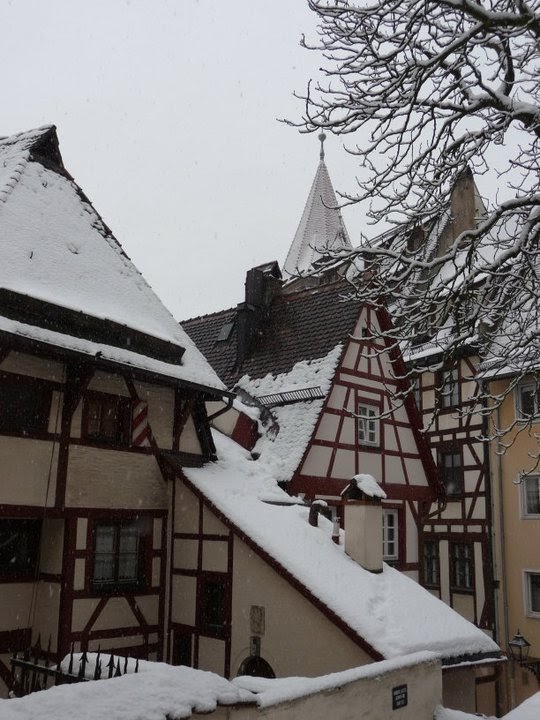
We got off the train in Nuremberg (German: Nürnberg) in a heavy snowfall. The train station took us under a broad thoroughfare and when we reentered the world, our hotel stood directly before us. We checked in, feeling sad that Hotel Victoria was clearly a chain hotel and not as quaint as family-owned Hotel Spitzweg in Rothenburg.
The snow continued to pour down on us as we left the hotel in search of food. The snow was so cold, it bounced off us and didn’t soak into our clothes. It obscured our view of anything more than a few yards away. In other words, it was beautiful. We stopped at a street vendor and bought the tiny sausages for which Nuremberg is famous. They were crispy on the outside, juicy on the inside, and served in a hard bun. They hit the spot. We enjoyed a glühwein before continuing to explore this charming city. We marveled at the architecture of the Gothic churches and massive city walls.


We made our way slowly uphill toward the Kaiserburg, Nuremberg castle. The imposing castle towered over the Old Town, built into the very rock of the hill on which it was perched. We had missed the English tour of the castle but wandered the grounds by ourselves. We went up into the great tower of the castle, climbed many stairs, and were rewarded with a breathtaking view of Nuremberg in a heavy snowstorm.


By this time, my feet were starting to complain about the hiking boots I’d brought to Germany, so we stopped in at a tiny café and had wine and chocolate covered gingerbread, or lebkuchen. We then wandered the city a while longer and stopped by the hotel. We used their WiFi to let family know we were safe in Germany and tried to get news on the airports. Because of the Great European Freeze that was currently gripping the continent, most flights in Europe, including Frankfurt airport, were grounded. We were beginning to worry about our chances of getting home, and the prospect of sleeping in the airport hung like a storm cloud over our heads.
We reemerged as dusk began to fall. The snow had finally quit. We wandered back to the castle to see it at nighttime. Children were sledding down the street into the roads and were unable to stop for hundreds of yards, shrieking with the fun of the misadventure. Cars were getting stuck in the thick snow that coated the roads. People were crunching through the snow on white sidewalks, talking quietly to each other or laughing raucously. It was a magical night. The snow clouds still roiled in the sky, lit by the city to a ruddy color.


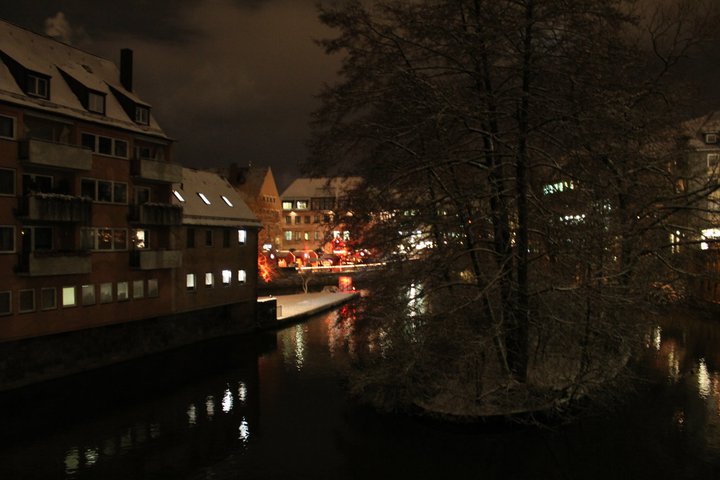

After a few hours of wandering and checking out the Christmas market, I led us to a small Italian café I’d seen in our wanderings. We had decided we needed to taste German Italian. It was here we had our first encounter with a service person who didn’t speak a lick of English. We ordered the special, ravioli, and were informed by the proprietor, a young woman with flaming red hair, that they were out. So we ordered pasta instead. We grew nervous as we watched her prepare our pasta in a microwave, but we needn’t have. It was some of the best spaghetti I have ever tasted, a simple marinara with a hard grated cheese on top, artfully garnished with basil.

To make up for the language barrier, we called over the waitress, the only person working there. “Schnapps,” I said. I pointed to myself. “Ein.” I pointed to Michael. “Zwei.” I pointed to her. “Drei.” One, two, three. She got the picture. She came and took a shot of terrific hazelnut schnapps with us. “Vielen Dank,” she said. Thank you very much. “Bitte schön,” I told her, grinning. You’re welcome.

We felt very proud of our ability to make it through a meal with only German language, and not a little tipsy from all the wine and schnapps. Feeling quite warm and pleasant, we walked through the snow back to our hotel, giggling together.

Friday, January 7, 2011

Christmas in Germany: Rothenburg ob der Tauber

We took the train from Würzburg through Steinach to Rothenburg ob der Tauber in the morning. It was just under an hour in transit. From the train station we walked about 700 meters through a normal bustling city toward the hotel.

And then, as traffic became less dense and the roads less well tended (there was a good six inches of snow on the ground), we rounded a corner and saw it. Imposing stone city walls, complete with towers and a wide stone gate. We were in Rothenburg ob der Tauber.


The name Rothenburg ob der Tauber means, in German, Red Fortress Above the Tauber [River]. The medieval Imperial Free City is situated on a plateau overlooking the Tauber river. Some of the foundations of the city date back to 950 AD.

To Nazi ideologists during WWII, Rothenburg was the epitome of the German town, symbolizing all that was quintessentially German. I can’t blame them. It seemed like the most German of all the German towns we visited. Throughout the 1930s the Nazis planned regular day trips to Rothenburg, to the pleasure of its citizens, who supported National Socialism.

In March 1945, German soldiers were stationed in Rothenburg to defend it. On March 31, bombs were dropped over Rothenburg by 16 planes, killing 39 people and destroying 306 houses, six public buildings, nine watchtowers, and over 2,000 feet of the wall. The US Assistant Secretary of War McCloy knew about the historic importance and beauty of Rothenburg; supposedly his mother had a painting of Rothenburg over her mantel. He ordered US Army General Devers not use artillery in taking Rothenburg. The local military commander Major Thömmes ignored the order of Adolf Hitler for all towns to fight to the end. He gave up the town, thereby saving it from total destruction. In other words, even enemies agreed that this was a special place, and both broke orders in its favor.


So many old cities promise that you can “step back in time” by walking their streets, but Rothenburg is one of the first where I have found that to be true. We could feel the history seeping from the half-timbered houses and the old stone wall.

We stopped at our hotel, Hotel Spitzweg. The house was originally a manor in 1536 and became a brewery in 1704. It became a hotel the year I was born. The proprietor, Walter, was a charming old man who took our small suitcases and sent us along to a restaurant, beaming.


We ate at Zum Ocsen. We were thrilled when the server asked us solicitously, “Was möchten-sie essen?” It was the exact phrase we had studied carefully: “What would you like to eat?” Michael ordered potatoes and pork loin, and I, using my handy German phrasebook, ordered meatloaf with potato salad. Much to my dismay, “meatloaf” was certainly a loaf of meat: it was some sort of barely cooked bologna. My vinegar potato salad, however, was divine. I made Michael trade meats with me and we ate our fill.

Bellies full, we wandered throughout the town until our legs got tired. We went into a little café, strengthened ourselves with wine, and then continued our wanderings through the fantastic town.


As we reached the Christmas market, it began to snow. Words cannot describe how magical Rothenburg is when it’s snowing.


At eight o’clock, we made our way to the town hall and met up with the Night Watchman. This guy was a trip. He had this squeaky, half-drunken way of telling stories about the history of the town, and even though it began to rain a few minutes into his tour, we stuck with him, shaking from the cold, until the bitter end.


We ducked out of the rain and into Hell—no, literally, we ate at Zur Höll, which means To Hell. The building dates back to circa 900 and is the second oldest in Rothenburg. I had amazing roast beef and Michael had the goose and dumplings. It was fabulous.


The next morning, we ate a traditional German spread—coffee, cold cuts, bread, and potatoes—at high speed because we wanted to catch the 9:10 train. Walter was sitting with other guests, chatting over their breakfast, but it was clear he intended to make his way to us in good time. When we stood to leave, he exclaimed, “You are finished?”

“Ja,” I told him. “It was very good. We just have a train to catch.”

He declared in his thick German accent, “That is the fastest breakfast I ever did see!”

We checked out. The rain from the night before had frozen into a thick coat of ice on the sidewalk, and Walter positively wrung his hands from the doorway, shouting advice on how to walk on the ice, as we trundled away. We hated to leave this picturesque city.

Saturday, January 1, 2011

Christmas in Germany: Würzburg

We spent Christmas in Germany, and what an amazing trip it was. It easily ranks as our best vacation—the memories, the sights, the food, the wine, and the snow… so much snow! We were in Germany for eleven days, not counting the two travel days.

We took trains from city to city and enjoyed looking out the window to spot a hare leaping through a snowy field, a brown-and-black deer stripping bark from a snow-mantled tree, or a white-winged hawk sailing along ten feet from the train (and keeping up). The trains were easy to figure out and prevented us from having to drive on icy roads.

Our first stop after getting off the plane in Frankfurt was to Würzburg. Würzburg is a city in the northern tip of Bavaria with main draws including the medieval Fortress Marienberg towering above the town and the sculpture-adorned Old Main Bridge. Unfortunately, Marienberg is closed October through March, so we only saw it from afar.


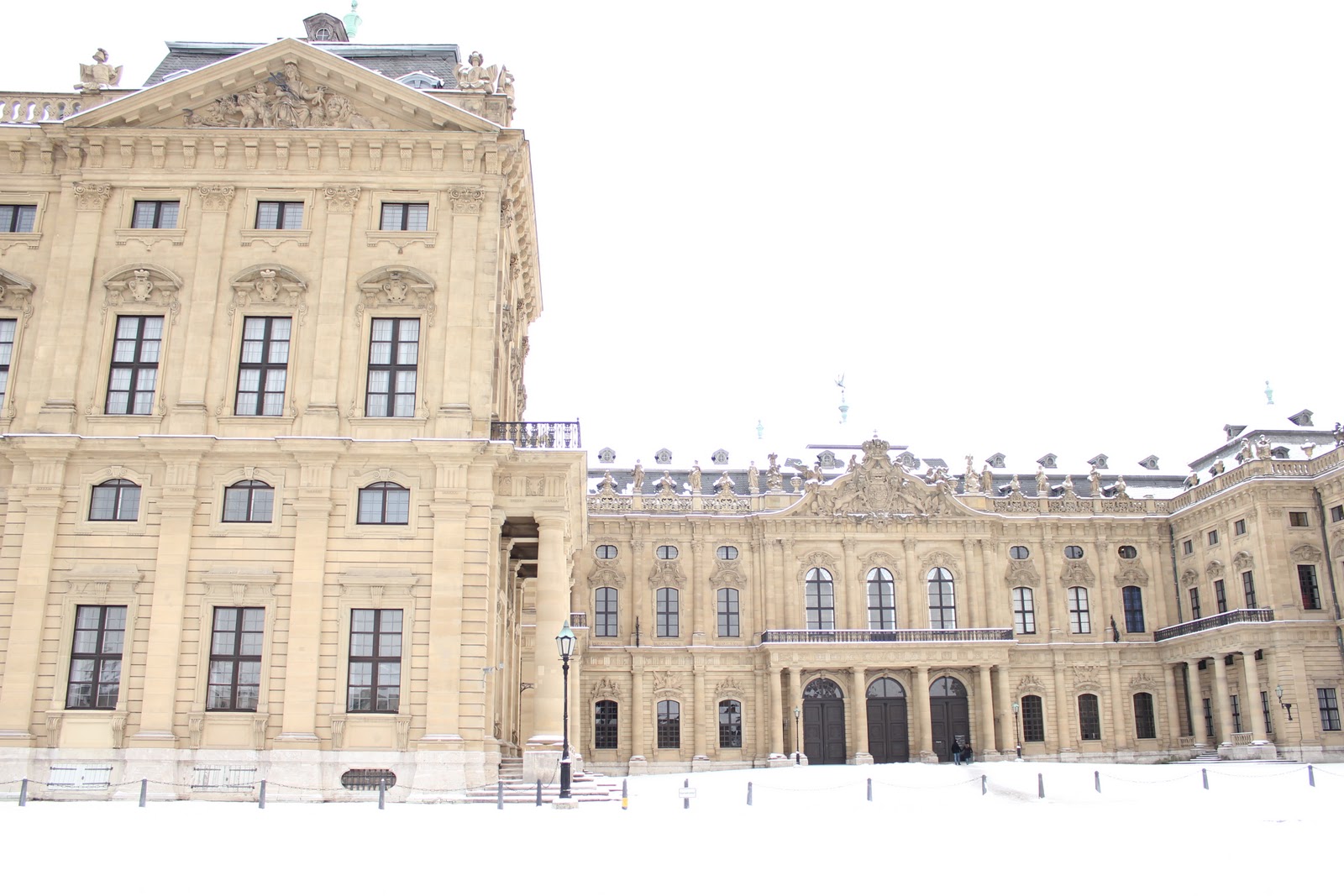
After settling into our hotel, Würzburger Hof, we made for the Prince Bishop’s Residence and enjoyed a tour of the palace, built in 1744. Although much of it was destroyed during WWII, it was completely rebuilt as it was before the war. No photos were allowed inside.


Afterward, we went to the Würzburg Christmas market. In Germany, each city erects small wooden buildings in town squares during Christmas where vendors can sell sausages, glühwein (a fantastic mulled wine which I have since made at home with great success), and other yummy treats; homemade goods; jewelry and clothing; decorations; and Christmas gifts of all colors and sizes.


We had dinner at Ratskeller, a historic Franconian wine restaurant with a long tradition. Michael ordered bratwurst with sauerkraut, and I ordered the lamb medallions with ratatouille. Everything was fantastic.

We made our way to a second Christmas market and enjoyed the contrasting architecture of a cathedral and a Christmas-light-adorned obelisk.


Jet lag was settling in, so we went back to the hotel and crashed after a brief walk through the stalls and a glühwein.