Thursday, December 18, 2014

La Negrita: Pilgrimage to Cartago, Paraíso, and Ujarrás

On 2 August 1635, a biracial girl whom myth calls Juana Pereira was collecting firewood in the forest when she discovered the small figure of the Virgin Mary standing on a rock by a stream. The statue was no larger than a doll and solid black. Juana took María home and placed her in a drawer wrapped in a cloth.

But the next day, she found the statue again in the woods, in the same place. Juana took her home again to discover the drawer was empty. On the third day, Juana brought the local priest, Alonso de Sandoval, and discovered the Virgin Mary once again in the woods. The priest took the statue back and placed her in a box. The next day, the priest discovered the statue had disappeared. So they went to the woods and found she was in her place again. They then brought her to the sanctuary to rest, but the following day, La Negrita, the little black one, had disappeared again. Once again, she was to be found in the forest.

So the people built her a fine basilica, the Basílica de Nuestra Señora de los Ángeles in what is now Cartago in the Central Valley of Costa Rica.

In 1824, the Virgin was declared Costa Rica’s patron saint. La Negrita now resides on a gold, jewel-studded platform at the main altar in the Basílica de Nuestra Señora de los Ángeles in Cartago. Each 2 August, on the anniversary of the statuette’s miraculous discovery, pilgrims from every corner of the country (and beyond) walk from wherever they are to the basilica. Many of the penitent complete the last few hundred meters of the pilgrimage on their knees. This pilgrimage is called the Romería.

This year, I started seeing pilgrims walking toward Cartago several days before 2 August, and I felt the fever reach a pitch. On my way to a friend’s farewell party in Santa Ana, I was waiting for a ride in my town San Pedro, watching literally thousands of people walk past on foot. The Calle Principal, an extremely busy and important highway, was shut down due to the sheer volume of people. They were very quiet, unlike the crowds that filled the streets during the World Cup. Barely speaking, just walking in the dark. Some of them had been walking for a long time. I watched as a girl tripped and fell over a low fence and lay there, exhausted and dehydrated. Other romeros stopped to help her up and give her a drink.


The next day, I packed a light backpack with water and a change of clothes. I walked out my front door in San Pedro and started walking.


San José and where I live, San Pedro, are in the Central Valley of Costa Rica. Around 4,000 feet in elevation but surrounded by mountains far taller, the weather is perfect for a long walk, warm in the days giving way to cool at night, and August is smack in the middle of rainy season. It started spitting rain when I left, but then it stopped, and although the gray skies threatened rain all day, it was an empty promise. I left at 10:45 AM.


About 20 minutes later I met my friend in Curridabat and we started toward Cartago. We decided to stay off the main street and walk along the train tracks instead. The grade is gentle as Cartago is in the highlands, and the street was choked with pilgrims. And so we walked.

We walked under surly skies among green, green hills.


We greeted unicorns in disguise.


We wandered beside rambling coffee farms, the branches heavy with unripe coffee beans, shaded by rainbow eucalyptus.


We walked through town after town. Towns that charmed me with their warmth. Each one boasted at least enough flat ground carved out for a football pitch, the neighborhood boys kicking around the black and white football with abandon. We stopped at mini-supermercados and bought milk and cookies and bananas to snack on.

The train went by only once. Fortunately it was not while we were walking across one of the bridges.


I eventually started to feel tired and perhaps a little cranky. This was perhaps after walking about 20 kilometers, when I realized I had forgotten to eat anything. We rejoined the road and stopped by a small roadside tent and purchased tamales. We donned our coats, as it was cool and foggy in the mountain air, and unwrapped our tamales with glee. We doused them with salsa Lizano and devoured every bite. My humor restored, we went back to the train line and kept walking.


Just before sunset, we reached Cartago. The train line dumped us into an extremely impoverished neighborhood utterly devastated by litter, and we kept walking as the sky began to stain gold in the late evening light. We explored the ruins of Cartago first. Dozens, hundreds of people filled the town square.


Eventually we came upon the Basílica de Nuestra Señora de los Ángeles in downtown Cartago. The sun was beginning to set and the plaza was packed with hundreds of thousands of people. Estimates put the number of supplicants between 800,000 and 2.5 million between 25 July and 2 August each year. I believe it.


As luck would have it, we found our way into the chapel at the commencement of some kind of ceremony, and La Negrita was being carried in her special glass case with her golden throne. I honestly wouldn’t have known it was her; she is so small and surrounded by so many loud and precious beauties. The faithful carried her out into the plaza to who knows where, and my friend and I walked out behind her to witness an understated rainy season sunset.


There she is!


We ducked into a seedy bar to have a small meal and stopped at a market before setting off again; it was full dark now, though the town still had the feel of an important day about it. We walked a ways until we could catch a short bus close to Paraíso. There we disembarked and walked another 40 minutes or so, mostly downhill in the pitch black through farmland, to a hostel that clung to the side of the mountain. The clouds were thick, but it was clear the view in the morning would be spectacular.

Spoiler alert: it WAS.


We let ourselves in around 10:30 PM and greeted the owner, who supplied us with home-brewed peach beer. We threw our things onto beds in the dorm under lurid paintings of superhero sloths and removed our shoes – having walked about 33 kilometers (20 miles). Meanwhile, a little boy wearing a cape zoomed around us. When I asked him what his name was, he said, “Power Ranger Mega Force ROJO!”


A campfire was lit that night and we sat beside it in the deep silence of the deep country.

The next morning my body protested movement. But eventually I pulled myself out of bed and took a shower and drank some fresh coffee. The view was indeed amazing.


We breakfasted and slowly prepared to leave. Power Ranger Rojo walked up to me and tapped me on my arm. I looked down to see him smiling shyly up at me, holding a tiny red flower in his hands. I exclaimed over it and put it in my hair. By the time I was waving goodbye, Power Ranger Rojo cried, “¿Dónde está la flor?” I stopped everything and waited for him to present me a new flower, as I had lost the old one, asked him for a little goodbye kiss on the cheek, and headed up the steep hill to the gate. Such a little Latin heartbreaker.


My friend and I walked away from town, down the mountain into the valley below. We cut through a workmen’s trail, barely usable for vehicles, though clearly it had been.


We walked all the way down into Ujarrás next to the Lago de Cachí, to see Costa Rica’s oldest standing church Nuestra Señora de la Limpia Concepción del Rescate de Ujarrás. It is a shell of a building now, originally built between 1651 and 1659. It is framed by tropical trees draped with Spanish moss, called barba de viejo or “old man’s beard.” It was beautiful, and the day was beginning to simmer with heat down in the valley.


Right and truly tired, my friend and I wandered into… honestly, I don’t recall the name of the town, just followed a road until we found a bus stop. We took a bus through Paraíso into Cartago, but it stopped and everyone was made to get off because there was a massive oxcart parade going through town and vehicles couldn’t get through.


We watched the parades and the weatherworn Tico cowboys for a while, and eventually got across to the main bus station. We caught the next bus to San José. We both fell immediately asleep for the ride back to the capital. My friend got off in Curridabat and I rode a tiny bit longer into San Pedro. I arrived at my gate just as it started to rain for the first time since I left.

Costa Rica is a complex and beautiful nation with a rich culture hidden from tourists under all the pura vida stuff.

We do live pura vida here, but it is not always in the way you might think.

Sunday, December 7, 2014

Coming full circle

When I moved abroad over a year ago, I knew it was for keeps. I was deliberately changing my life. Over Thanksgiving, I went back to Tennessee to visit my old world for the first time. I am happy to report my mission has been a success.

Back in Tennessee, every person I ran into did a double-take upon catching sight of me. Although most of them have me on Facebook or Twitter or at least this blog, they couldn't believe this woman is the Jessie they knew. In a single glance, it is obvious I am very different. Most of them would say something along the lines of, “You look great!”

Some changes are superficial. I have lost 20 pounds. My hair is sun-bleached. My skin is toasted pancake-brown.

There are no words to say how great it was to cuddle these guys.

But other changes are both more subtle, and more powerful. I smile more. A lot more. I stand taller. I talk more freely, peppered with laughter. I am less reserved. I engage those who matter, and blithely ignore those who don’t. I don't react to negativity anymore. My energy is ALIVE. I have pulled a 180 in the best way.

Coming back to Tennessee made everything stand out for me. First, the darker comparisons:

The main reason I returned was to be a bridesmaid in the wedding of one of my dearest friends. I did catch myself slipping back into my old personality a couple times—somewhat peremptory and officious—when we needed to get everyone where they needed to be. I’m afraid I haven’t eradicated that side of me, although it’s the first time I’ve acted like that this year.


My little brother baited me, as always, spoiling for a fight. I pretended not to notice, and nothing happened. I used to react strongly to being treated that way, and end up in a nasty argument. Not so now. By the end, he was actually apologizing to me.

A girl who was supposed to be a good friend cut me off when I needed friendship the most, at the time I got divorced. I even reached out to her at the time, told her it hurt my feelings and I needed a friend, and she said she was “on a fence”—meaning had to choose between my ex and me. I worked very hard to ensure my friends weren’t put in that position, and she is the only one who felt the need to drop one of us, and she picked me to drop. Eventually she deleted me on Facebook. I’m no longer hurt by it, though I was for a long time, and when I saw her, I just kept my distance. I gave her the chance to make things right and she didn’t. But the beautiful thing is I did not then sink into depression and agonize over what I did wrong. She is not a good friend, so I’m well shot of her.

Speaking of my ex, he was at the wedding. We both pretended the other didn’t exist. He’s still with the girl he started dating before our divorce was even final. This doesn’t arouse jealousy or anger but rather pity, that he can’t be alone. He left his girlfriend of 7 years for me, so there is clearly a sad pattern here. He wears fake eyeglasses now, which was like a shining little gift to me. If I ever felt uncomfortable, which was only once, I simply said to myself, “Fake eyeglasses. FAKE eyeglasses!” I haven’t seen him since the divorce, and I wasn’t sure how I would feel seeing him. Thankfully the rage is gone, and the heartbreak too. I felt only bafflement that I could ever spend so much time in an emotionally abusive relationship with an unworthy man.

But otherwise, everything was highlighted for me in the limelight of positive change.

I attended a reunion of my KidLit writing group, and one of them (love you, Jamie) said, “JESSIE. I have never seen you write like THIS!”


I went to lunch with my former boss and mentor, and did a quick round around the old office, and you wouldn’t believe the reactions people had. Many of them hugged me. I was surprised at how many of them said they read this blog. (Hi, guys!)

I went to my favorite pub, McNamara’s, and something like 20 friends showed up to say hello. They played my favorite song, one that I feel was almost written about me called “Beeswing,” a Richard Thompson cover.

I danced like a loon with my little nephew in the aisles even though no one else was dancing. I used to be embarrassed about what a bad dancer I am. My ex once danced with me and 20 seconds into the song he said, “You’re really not good at this, are you?” Talk about hurt feelings! I never danced in public after that, until I moved to Costa Rica. Now, I am still a terrible dancer—I mean truly bad—but the difference is I do it anyway, with no shame or fear or embarrassment, just joy and abandon.


With most people, I was able to pick up right where we left off—sort of. I mean, I’m different for sure, and some of the things they talked about, I couldn’t truly relate to, and I know the feeling was mutual. But that wasn’t bad in any way. Just different. I sang Frank Turner’s “Four Simple Words” with one of my friends, bellowing it at the top of our lungs like old times. I had Greek gyros with another and we were able to talk together as if no time had passed. I went walking at Radnor Lake and the trails that used to get me a bit winded were easy-peasy, and the friends I hiked with and I laughed and chatted away.


It was absolutely amazing to see my mom. She and I are very close and used to hang out together almost every Sunday. I haven’t seen her in over a year other than Skype. She and I went walking back through her property through the fields and juniper woods, splashing through the creek and talking up a storm. We went to lunch, watched movies, cooked together, and thoroughly enjoyed her company. I’ve missed her a lot.


All summed up, going back to Tennessee for a week was good because it allowed me the ability to reflect. I’m so much better, so much happier than I was before. Sure, I still have plenty of flaws, and I’ll never ever be perfect. I still have lots of work to do in this journey of self-improvement. But I am glad at who I have become, where all this hard work has landed. Proud, even. This crazy step has been the best choice I could possibly make in my life.

And when my plane descended into Costa Rica beneath the cloud layer and San José appeared like a nest of golden fireflies in the velvety night, I was even gladder to be home. Because let’s face it. I didn’t “go home” for a week. I just visited the place where I used to live.

Costa Rica is my home.

Monday, October 20, 2014

Finding your tribe and learning to let go

Find your place. Seek your tribe.

Last week marks eleven months since I moved abroad. For some people, that’s bastante – quite a long time. For others, it’s nothing. In general, when people here ask me, “¿Cuánto tiempo tiene en Costa Rica?” (How long have you been in Costa Rica, or literally, how much time do you have here?) My response is usually, “Ah, sólo tengo 11 meses.” (I ONLY have 11 months, with stress on how little time it is.)

However you define 11 months, it has been long enough for me to encounter some very strong feelings of otherness.

I have a theory that, when a person decides to travel long-term, she does so because she is looking for her tribe. She is seeking other people who “speak her language.” She may not think of it this way or consciously seek this. But many times, a traveler will discover that the people who best “speak her language” don’t even speak the traveler’s native tongue. I have found this to be true for myself.

A friend shared with me this letter. It’s beautifully written, especially this part: “How do I find the right words to tell you, to confess that it has been easier to pour my heart out to new friends on the road than to you in the many years I’ve known you? There are no right words to tell you that although they’re all a thousand miles away, they know me better than you do.” It was written from a woman to her lover, but I feel like it could be written from me to many of the people in my “former life.”

Change and evolution gives you wings.

One of the most incredible friendships I have ever had was found here in Costa Rica. This person launched rapidly into my heart. I have never been able to talk to anyone, ever, as well as I have him. He speaks my language. He is part of my tribe.

This is no comment on the quality of the friendships I had before, or the amazing people I used to hang around. They’re still wonderful, and I love them to death. This is not a rebuff of their worth. They shaped me, changed me, and our spirits danced together for a while, or for a long time. They were part of my tribe and they continue to mean a lot to me. They helped me through the hardest times I have ever gone through and I will never forget that. But as it turns out, they speak English, but in many cases now, they don’t speak my language. At least, not as well as they used to.

The truth is, after almost a year abroad, we don’t have as much in common anymore. Their lives have carried on, and my life has pirouetted and danced along its own path as well. The things that matter to us now are very, very different. I can’t talk about what is important to me, my dreams, my thoughts, my burning questions about life, my experiences, my observations, my SOUL, without sounding insincere.

The path is not always easy.


Other than my ex, there have been three people whom I have made a conscious choice to walk away from. For one reason or another, they are not good people to continue to be in my life, so I stopped interacting with them. It’s tough. Each time I made this choice, I questioned myself, worried that it was my fault, overanalyzed every interaction, even cried. Ultimately, though, it was the right decision. As someone who has struggled mightily with depression all my life, I can tell you with certitude that my life minus the most negative person I know equals about 80% less depression. Subtract the other three, and make that 90% less depression.

Be open to changing course. In fact, embrace it.

But what about the others? With a couple special people, nothing at all has changed. That’s great. But with the majority, I am generally less important to them. I am no longer their best friend (in some cases I never was), and I should not pretend to be. I still love and care about them and hope the best for them, but I can do that from this new distance that has nothing to do with terrestrial mileage. I can appreciate what we had, and what remains. I don’t have to pine away for what has changed. I chose this path, after all.

If you are human, you will evolve over time. If you are actively trying to change your life, like I am, this should happen rapidly. Often, this happens separately from the people around you. And that’s okay. You can still care and it doesn’t have to be the same as it was.

Even as you evolve and seek your tribe, even as you seek the people who sing to your soul, you can gently let go of the ones who sang to you previously, and always treasure their song in your memory. Their specialness does not fade as your paths diverge, even when others take up a more prominent residence in your heart.

Never stop moving forward along your road, whatever it may be and wherever it may lead.

Wednesday, September 24, 2014

El Salto

When I moved to Costa Rica, it was a conscious decision to change my life.

A lot of expats I meet got here almost by accident. They came for something finite, short-term. They came for vacation, or to volunteer, or to learn Spanish. They came, they fell in love with the country, and they decided to stay.

I’m the weird one who knew I was moving here long-term from the beginning.

I finalized my divorce and changed my name with all the various government agencies. I quit a job I had held for seven long years. I sold my half of my mortgage. I sold my car. I kissed two of my amazing dogs goodbye forever, and the other two I snuggled close, not having any clue when I would see them again. I put my remaining belongings in storage. My friends threw me a farewell party. I packed my suitcase. And I LEFT.

I knew not one single person in Costa Rica. I did not speak Spanish. I had zero job leads. No idea what city I’d settle in. I just… moved.

The first ten days, my mom joined me. We traveled around doing the touristy stuff. Ziplining, horseback riding, swimming in waterfalls, getting massages, that kind of thing. About nine days later, though, I dropped her off at the airport, and my new life really began. Although I had already made a couple of Tico friends, for this next stage, I was utterly alone.

I took a shuttle down to Quepos. It was supposed to pick me up at 9:00 AM. I waited until 9:30 before calling. They told me my school had forgotten to pay for my shuttle. So I waited at a Denny’s in Alajuela for four hours for the next shuttle. It sucked. I was anxious, and uncomfortable, and a little sad from watching my mom walk into the airport with tears in her eyes. It was a very long four hours.

Finally the shuttle arrived and I sat next to a charming girl from Canada with roots in India. Her name was Alisha and she was going on a yoga retreat. We were both quiet for the first hour, but soon became chatty. We exchanged information when she got out an hour before my stop. The road got darker and darker, and I was the only one in the shuttle. The road climbed a hill and then BOOM. Pacific Ocean to the right, glowing with all the colors of a blood orange in a spectacular sunset. The driver asked if I’d like a photo. I grinned and said, “¡Por favor!”

Standing there looking at the Pacific Ocean for the first time since I was 13 years old, I suddenly realized why my shuttle was late. It had been late so I could experience this one perfect, breathless moment. I snapped a photo with my camera, and it promptly broke.


When I arrived in Quepos and got out, a smiling lady and muscle-tee-clad gentleman were waiting for me. Oh, god, it was so hot. I wilted within 30 seconds. The lady said my name, “Jessie?” with a question mark on it. “Sí,” I said, and with that almost exhausted my conversational ability. This was my host family for the next four weeks, then.


The man, Rolvin, took my suitcase and the lady, Mileidy, began chattering happily in Spanish as they led me through the deepening gloom. I looked around with trepidation. Quepos is, at a cursory glance, a little ugly. Rusty corrugated tin roofs are tossed together over piecework construction. The roads are pitted and the ocean isn’t visible from town even though it’s on the water. We crossed over a smelly creek choked with plastic bags and styrofoam cups, and turned down a nondescript road to arrive at a house locked tight with metal bars and barbed wire (this is typical all over Costa Rica, to keep out burglars). She handed me a set of keys, led me up a very narrow staircase, and showed me my room. It was one of 5 doors off a balcony, but there was no one else around. The room contained a desk, a chair, a floor fan, a bed, and a shelf. That’s all. Rolvin deposited my suitcase and they told me what time breakfast would be. They left, shutting the door behind them.


I stood still, holding my arms and legs apart so they wouldn’t touch. It was so HOT. I was completely drenched in sweat and had only walked five minutes. There was no air conditioner. I locked the door, turned on the floor fan, stripped down to my panties, and stood in front of the fan. I was completely alone. I may have hyperventilated a little, standing there and letting the insanity of what I had done with my life finally drizzle down my skin along with the never-ending sweat.

By morning, I was less panicked, but only somewhat. I took a cold shower in a shared bathroom, dressed, and went down to breakfast. There, I met two of the other boarders, a girl from Germany and a girl from Switzerland. Mileidy served a lovely breakfast of fresh pineapple, papaya, eggs, toast, and gallo pinto, along with coffee. She sat at the table with us and talked pleasantly. She was remarkably easy to converse with despite never saying a word in English. The girls were friendly, and I overheard them mention a waterfall.

Let me be clear. In the States, I was a very shy person. Not among friends, but I was paralyzed when it came to introducing myself or trying to meet new people. It was agony. I was married to an extrovert who loved attention, so I was never challenged in this. I was allowed to wallow in my shyness.

I asked the girls, “Did you say you were going to a waterfall today?”

“Yes,” they said. “We’ve never been there but just heard about it.”

I steeled myself and just came out with it. “Do you mind if I join you?”

“Of course! Just grab your things and meet us in the street in fifteen minutes!” They both smiled, and we exchanged names--they were Chrissy and Daniela. We put away our dishes together.

Elated, I rushed upstairs and packed a daybag and put on a swimsuit. I had ASKED! And they said YES! This was HUGE. The old Jessie I left behind in the States would have never done that. Never.

At the bus terminal, we met up with more of their friends, a guy from Germany and another girl, I think also from Germany. They were all studying together at a local Spanish school. (Bonus side note: I am now a Director at the headquarters for that school.) Everyone introduced themselves to me and tried to remember to talk in English for my sake instead of German, which they all knew. We grabbed a bus and paid 375 colones to ride. We got off just five minutes later at an unmarked bus stop.

It was only 9:00 in the morning and already blistering. None of us had any idea where we were going. We walked down the steep hill for a while, looking for a trail, then back up. Finally we asked a shirtless man hammering away on a roof, “¿Dónde está la cascada?” He pointed vaguely back the way we had come. We were pouring sweat. God, it was hot here.

Finally we found the trailhead and entered the blessed shade of the jungle. It was forest that quickly melted into jungle, no slow petering out of civilization, no neat trail maintenance, just a footpath through the jungle. The sound of rushing water was near.


It became apparent that my newfound companions were not big-time hikers. After twenty minutes, they started wondering if they had it right, and were debating turning around. And I, the shy girl, took to cajoling them, saying, “I’m sure it’s just around the next bend. Just a little farther.”

The trail abruptly ended at a river, where there was a guy sitting on the bank messing with his walking stick. We introduced ourselves around. His name was Dago, and he was from New York with Cuban roots. “Do you know where this place is?”

“No,” I said before anyone else could. “But it can’t be far now.”

We left him there and started walking in the riverbed itself, calf-high in water. My broken camera chafed at me. I ached to capture this glorious rainforest in a photo or two hundred. The bright morning sunlight streamed in perfect golden beams through the thick, verdant canopy, and the water was oh-so-clear. My new friends were laughing and joking and we were all asking each other questions about who we were, where we came from, why we were here. It was amiable and easy. Not at all awkward or stilted for having just met each other.

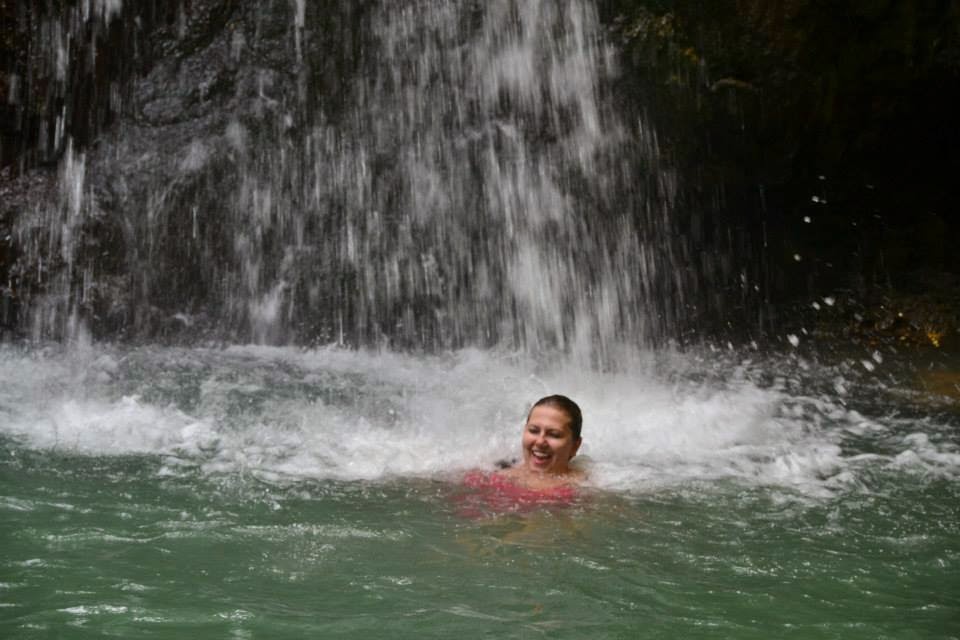
And all of a sudden we came upon the waterfall. It wasn’t much, really, a fifteen foot drop off a cliff into a clear blue pool. Dago caught up with us then, and together we discovered the only way down to the swimming hole was a ratty nylon rope tied to the cliff. One by one, we rappelled down and stripped to our swimsuits and delved into the icy pool.

I'm happy to say I've lost about 15 pounds since this photo was taken.
So refreshing! Soon the area rang with our shrieks and laughter. We explored the pool carefully, deemed it safe enough, rock climbed back up the rope, and leapt repeatedly off the waterfall into the pool. When it got too cold, I slithered up onto a rock in the sun and rested, surveying the scene. Dago climbed up next to me and we began chatting. It was real talk, about how different it was here, and how no one back home really understood what life was really about, and how much we appreciated paradise, and how paradise was not just a bunch of stuff. By noon, we were fast friends.

We had the place to ourselves; not a single other hiker interrupted us all day. We all laughed together when the ants attacked our backpacks—and my unfortunate flatmate Chrissy. We all shared snacks when we got hungry. We all cheered each other for giant leaps off the waterfall. One of my jumps ended poorly and for the next week, I had a massive black bruise on my inner thigh from my knee allllll the way up.

I pushed into the water and employed a dead man’s float. The water in my ears silenced the world save for my steady breath, and I stared at a sky so blue it made my heart hurt. Exotic birds occasionally flitted across my field of vision. In less than twenty-four hours, I had gone from blind panic to the deepest, most serene, most content peace I have ever felt.

That feeling has never really left me henceforth. Oh, I’ve had bad days, faltered, felt lonely or lost sometimes. But really all it took was one perfect day at the waterfall (“El Salto”) with five people I had never met before, and the knowledge, sure and unshakable, that I was capable of doing this crazy thing. Everything was going to be all right.


Everyone in that picture but me has since left Costa Rica. But they left behind a shimmering memory that will never fade.

All photos except the sunset and the homestay taken by my friend Dago.

Thursday, July 24, 2014

Stuff

Ever since I moved to Costa Rica, I’ve caught myself bragging… yes, BRAGGING about how little I have.

I boasted about the time I made a cake with no measuring cups, mixing bowls, and whisks. I called it “adventures in minimalist cooking.”

I babble about the stuff I DON’T have in my house. I proudly list them off: no table (kitchen or coffee), no microwave, no screens in my windows, no countertop kitchen appliances of any kind (other than a coffee maker, which I broke down and bought), no heater, no air conditioner, no bathtub, no television, no car, no dishwasher, no radio, no mobile device with internet capability, and only enough clothes to fit in a suitcase.

I joked about the fact that I started a running routine with no running shoes (I used my hiking boots instead).

I gloated over the night I had company over to my house and we all had a “picnic” on my living room floor because I didn’t have table or chairs for them to use.

Costa Rica isn’t a third world country in the middle of some desert somewhere. I live in San José, a city with 2 million people. Things are available. Granted, imported items are extremely expensive. To give you an idea, I went and bought a pair of workout pants and a tank top on clearance plus two 6-pound dumbbells for working out. Just that cost the equivalent of $75. And not at the fancy store, either. Terrain in Costa Rica is very difficult to navigate, with crazy steep mountain gravel roads, driving up the price of imported goods. But they are available if I wanted them.

The big lesson I’ve learned, though, is that I don’t NEED things. And that’s why I catch myself bragging. Really the only thing about it that’s NOT worth bragging about is how long it took me to realize this.

I did everything right. I did the stereotypical American dream. I graduated college. I got married. I bought a house, owned property, worked a long-term cushy office job, drove a decent car. I had a pool. Twenty one hundred square feet, every inch polished and perfected. I planted roses and had the neighbor’s son mow my lawn. I bought art, knickknacks, kitchen gadgets, furniture, jewelry, clothes. STUFF. I was well on my way to middling mediocrity.

That path? Yeah, it wasn’t for me.

I came here with a suitcase—okay, a massive suitcase, but still—and I haven’t acquired much more along the way, except a coffee maker and some dumbbells, and having my scuba gear brought down, oh, and all those vitamins from that time I visited Texas for work.

My house here is pretty great. Those few who are invited in say it’s nice. It has lots of windows and good light, it’s roomy for one person, and there’s even a little paint on the walls. So my landlady plays pop music… on repeat… right next to my bedroom… for hours (so much so that I once threatened to move out). So my “green space” is about one foot by three feet square. So I kill a cockroach at least once a day. So I had to plug the wall with cement because of the rats. So my curtain is held up by push pins. So my headboard is just leaning against the wall and makes a terrible clatter if it shifts. It’s all I need. I don’t want more. I get stressed out just thinking about having more.


I have learned to have a little and delight in it. My quilt I bought in Guatemala is my prized possession. Partly because it keeps me warm. I recognize things like floor fans and clothes dryers and ovens as the great luxuries they really are. I appreciate things a little more.

Quality of life, I’ve learned, is your reaction, not the stuff you surround yourself with.

People ask me about my long-term plans. This is it, baby. I already did the “right” thing. I already lived someone else’s dream. It wasn’t a good fit. For now I’ll stick to my tiny, ill-equipped, but good-enough apartment and listen to the house gecko sing by candlelight.

Oh, I’m sure I’ll evolve again, do something else, live somewhere else, maybe even acquire more stuff. But this? For now, this is the good life. And I’m proud of it, because I built it. Not the house, but the life. And the minimal amount of stuff I put in it.

Sunday, June 15, 2014

Recognizing beauty... EVERYWHERE


I’ve always been someone who finds beauty in unexpected places, but that part of me has been amplified since I moved to Costa Rica. I’m not trying; it just happens. I approach every new day with an unfailing sense of wonderment. I’m far from being jaded to the point that small things that others don’t notice fill me with childlike delight.


I wax poetic when the thunderstorms roll in and a hard rain settles in for the afternoon and night—despite the fact that I have to walk home through running water and sideways rain and I’m completely bedraggled by the time I get there.


I am enchanted by things others find ugly. Rusted tin roofs and graffiti and volunteer tomato plants growing randomly in the sewers. Leaf cutters walking across the sidewalk and hunched little old ladies who wish me buenos días on my morning run.


I appreciate all types of people I encounter even if they aren’t my favorite personality type. I love meeting people and I also love being alone. If I go downtown and walk among the jam-packed Avenida Central on a weekend, I can’t stop grinning over the raucous, teeming crowd.

Cloudy skies make me cry out with joy over how they resemble watercolor paintings. I exclaim over blue skies. Pink sunsets and slow gray dusks make me point upward and talk about the beauty there.


I recently spent a month with a roommate from a different culture. Several weeks into living with him, he mentioned he had never seen a Cheshire moon before and was surprised at how often that happened in Costa Rica. As far as I am aware, Cheshire moons are common everywhere, not just here. I was confused until I realized that he had simply never made a habit of looking up. But he lived with me, who said, “Oh, look at that amazing moon,” so many times, it opened his eyes to all the different moons there are.


Instead of engaging people who bring me down, I simply walk away. I don’t have time for their dramas and I refuse to be subjected to their negativity.


And THAT, my friends, is what has really changed in me. I spent over ten years loving someone who was negative at least 5 minutes out of every day –and sometimes 24 hours out of the day. I engaged it. I tried to help. When that didn’t work, I was sucked into the negativity. I was hurt. I was angry. I cried a lot. I never got real apologies and I had to be fine with weathering it until it passed.


How liberating it is to remove myself from other people’s crap. And of course, Costa Rica is very pura vida and most people don’t walk around upset and grumpy and nasty. I had a person tell me the other day it was beautiful how I laughed, beautiful how I even laughed at my own expense, beautiful how I found joy and humor in little things. I had another person say she craved my positive energy. I’ve also been teased for finding simple things extraordinary, but I am proud of this part of me.


My secret? Love yourself first. Take care of yourself, honor yourself. Put yourself in an environment that makes you happy. Back away from melodrama. And look around at how much beauty there is.


Tuesday, May 27, 2014

Cultural fetishism - the sexualization of white skin

I often laugh and joke about how “well appreciated” I am in Latin America. But really, cultural fetishism is no laughing matter.

The last few weeks, I have been running every morning. I get catcalls, whistles, and honks. You can follow my progress through my barrio by listening for cries of “guapa” and “la princesa.” It’s so extreme, once I caught a man behind the wheel of a moving pickup truck taking a photo of me.

I'm a young white woman who is often alone. I have naturally blond hair that is only getting blonder from the Costa Rican sun and the slightly chlorinated tap water coming out of my shower head.

Apparently, I'm just the right type.

One of the things I love about Costa Rica is the women. Ticas are proud of being women. They dress how they want and carry their heads high. This is not a culture where women are suppressed and hidden and expected to fade into the background. These ladies are tough and strong, or at least they outwardly project an illusion of strength. I think part of the reason is because they have to be. They’ve grown up in a machismo culture and instead of bowing to it, they stood up even taller. They are bright and smart and interesting and funny and kind. Not to mention how many are drop-dead gorgeous.

So why do men here desire extranjeras, foreigners, instead of these awesome women who are right in front of them?

Cultural fetishism is harmful not only to the people being fetishized, but also to the group being ignored.

Costa Rica is not as jammed and littered with billboards and advertisements as the United States, but where you do see ads, if a woman is pictured, she is almost always light-skinned or white, with light colored hair. These ads set up a cultural standard for beauty that is unachievable, because the majority of women here are born with lush, beautiful black hair and lovely complexion in various shades of light tan to brown. These advertisements encourage the fetishism of light-skinned women and send a message to the others that they are not desirable.

I want to rip down those billboards every time I see them.

This cultural trend (perpetuated by beauty and personal product corporate conglomerates which are usually foreign-owned themselves) is extremely unhealthy to the women and girls who live here. I went to a cosmetics store the other day and bought mascara and soap. My purchase qualified me for a free gift and I hardly paid attention to what it was until I got home. Then I realized I had been given skin whitener. I was horrified. Why does skin whitener even exist? Because we make women with dark skin feel they are not beautiful.

Fetishism also hurts the person being fetishized—in this case, people who look like me. I cannot go a single day without at least one person leering and catcalling. I am openly and brazenly objectified. I changed my walking route to work because of a creepy security guard who absolutely will not shut up when I walk by him, the entire time I am within sight. When I was visiting Nicaragua, men literally barked like dogs at me as I walked down the street. I am called out, hypersexualized, and constantly have to deal with unwanted attention.

I usually laugh it off and try to take it as a compliment. But it would be nice to be genuinely complimented rather than shouted or honked at. It would be even nicer to have someone interested in my mind rather than my physical appearance.

I wish marketers would present women of all shapes and sizes and colors as beautiful. And I wish men wouldn’t be so stupid as to swallow the current messaging out there.

Come on, guys. You’re getting egg on the faces of good Latin American men.