Wednesday, March 26, 2014

Inertia versus kinesis: making a reason


There is a common phrase that goes like this: Everything happens for a reason.

I am not a fan of that adage. It implies that we should sit passively and wait for good things to happen to us. It implies that we should relinquish our desire to work to change bad things because they’re happening for some grand reason we don’t understand. I don’t think it is wise to take such an idle approach to the only life you have. I’m more of a take-life-and-beat-it-into-a-pulp-with-a-stick-until-it-rises-to-your-expectations kind of lass.

I believe that you can make the best of everything that happens and make it fuel for a good change in your life. Some would say I am splitting hairs and really just expressing the sentiment of the proverb above. But I think it’s an important distinction.

Sometimes, you have to fight for your life. You have to work and sacrifice and bleed to get to the peak or you will be Sisyphus, forever stuck at the bottom of your hill. You can—and should—take misfortune and hurt, pull yourself up to stand high above them, and improve your life because of them. But it takes work. It doesn’t just happen.

Sometimes people say to me, “I wish I could do what you’re doing.” Most middle-class Americans I know CAN do what I’m doing but are unwilling to make the hard choices I did. I grabbed the deepest pain I have ever felt. Once it was made clear to me I could do nothing to salvage my old life, I transformed that pain into the biggest opportunity I have ever had. It took liquidating my entire life, bidding my friends and family farewell, hugging my precious dogs for what may be the last time, resigning my long-term job, facing utter solitude, and coming to live in relative austerity, but I did it. I am quite happy I did and would not change a thing about where I am right now. But that doesn’t make what I did any easier. It was the hardest thing I have ever done. Being a phoenix involves walking through fire before you can come out golden.

What I did is not for everyone; please don’t take all this pontificating to mean that I think it is the only way or the right way to go about life. Not everyone is as crazy as I am. Although it was right for me, every person is different, and those who choose a different life are not ignoble or somehow less-than.

However, whatever your path, don’t sit around and wait on life to come to you. Get up and start chasing your life until you have it in your grasp.

Tuesday, February 18, 2014

If you haven’t tried international volunteering yet, do

I came to Costa Rica to teach English. I took a month-long college-level course and am now internationally certified for Teaching English as a Foreign Language (TEFL). Before I even graduated I started sending out job applications, and I landed 6 interviews for teaching jobs. But life had different plans for me, and when I was offered the role of Director of Client Services and Admissions of an intercultural center that offers TEFL courses, Native Spanish programs, English lessons, and International Volunteering and Internship programs as well as Adventure packages, I was hooked and said yes.

Operating a bicycle-powered coffee depulper in Guatemala
My job is in Costa Rica but we also have locations in Guatemala and Perú. Therefore, promptly upon starting my job, I took off on a 20-day visit to La Antigua, Guatemala, and Cusco, Perú, to get to know our operations, staff, and volunteering projects in both countries.

I never thought I would be interested in volunteering at all, to be honest. Although I have traveled to 14 countries now, all of my travel has been about experiencing the culture and not lending a hand. It’s been for me.

But I have fallen in love with international volunteering.

In Guatemala, I worked on a coffee plantation, played with girls at a home for sexually abused girls who have been removed from their homes, lent a hand at a home for severely disabled children, worked at a medical campaign at a school to teach kids hand-washing and tooth-brushing and get them medical care, visited a shelter for over 300 dogs and a donkey, checked out a sea turtle conservation project, visited the conservation project at Lake Atitlán, talked in Spanish with the man who runs a construction project about his needs, and handed out snacks and taught English at an after-school program for 97 kids in a place with 3 staff members, none of them paid.

Playing hopscotch with abused girls

Learning hand-washing in a country without potable water

Feeding a starving dog an apple because that's all I had

Filling eco-blocks with plastic bits for construction filler

Protecting turtle nests

Cleaning up the lake

Giving what we have

Helping kids get to school without a bridge

Making friends with cheerful kids

In Perú, I walked 30 minutes on a mud road to play with kids at an orphanage, dropped in on a free evening English class for adults run solely through volunteering, installed drywall in a school with my bare hands, cleaned animal cages at a zoo, talked in a mix of Spanish and Quechua with the leaders of a tiny village in the Sacred Valley, spooned with a monkey in the Amazon jungle (no really), toured two orphanages and discussed their needs with the directors in Spanish, visited 5 medical projects from large hospitals to clinics with dirt floors, and helped coordinate activities at a home for children with special needs.

Getting splattered with mud on the way to an orphanage

Meeting a volunteer host family

Working in a tiny village

Sleeping with a monkey

Being creative with what we have


Looking deeper than the pretty surroundings

Working with animals

Even though I would have never thought of myself as a “humanitarian,” I’m addicted to helping out. I have always been very aware of my privilege in this world, but I did not understand the power of actually doing something to physically help out. I thought I was experiencing other cultures when I planned my own independent travel and visited all those countries. Now I realize I was only barely scratching the surface.

Sitting in the Sacred Valley talking with a woman in my sketchy second language and a third language I have never spoken before about what volunteers are needed to do for the village (making dyes and weaving, cooking for workers, working in fields and pastures, making adobe bricks, building houses, and so much more) while she asked anxiously if everything was up to my standards was such a special experience. If I wasn’t involved in a volunteering program, I would have just driven on through and marveled at the idyllic setting. I would have never connected with the quiet and beautiful culture of the Andean rural people.


Holding the hand of the boy with special needs as he struggled to walk around the block at a home for disabled children was eye-opening for me in terms of the availability of therapy and care in poor regions. The fact that he hugged me in thanks afterward was rewarding. Had I not been involved in international volunteering, I might have only seen the pretty church in that neighborhood, and I may not have noticed all the glass and nails in the street that I worked so hard to help the little boy avoid.


Handing out 97 cups of special oatmeal and chewable vitamins to reduce the appearance of white spots on the cheeks of very poor children aged 5-17 due to malnutrition, I understood on a personal level—not an academic one—the incredibly basic needs that are not being met in much of the world. If I wasn’t working with the volunteering program, I would have never seen how happy kids can be even in difficult or even desperate situations.


Volunteering on the coffee plantation gave me the chance to have a long conversation, in a language I am still learning, about the life of a kind and gentle woman who has worked on coffee farms since she was a babe. And painstakingly sorting each individual bean by hand into “buenos” and “malos” helped me appreciate the amount of work that goes into what so many take for granted.


Going to the Amazon and coming across all the landslides and a wreck that resulted in a man’s death helped me realize the fact that merely getting in a bus is taking your life into your own hands.


Watching the sexually abused girls hug the male volunteers in greeting brought home the HUGE impact of volunteering… the fact that the girls would even smile around men is a testament to the change wrought in their lives by volunteerism.


It’s powerful stuff. As a matter of fact, it’s a powerful world.

If you love to travel but have never rolled up your sleeves and volunteered in a new place where people need your help, you should try it. It’s a whole new way of experiencing the world and I can’t believe what I was missing out on all those years of traveling just to see the sights.

Get out there. Get dirty. Get humbled. Get inspired.

Saturday, February 8, 2014

Aggressively peaceful

Ever since I moved overseas, I think an apt description of me could be “aggressively peaceful.”


Meditating at Machu Picchu, Perú
Every angst, every shred of fear and hurt and worry—all of it sloughed away when I embraced my new, simpler life. Costa Rican Tico culture settled on me like a soft blanket, muffling the noise in my head.

Indeed, the only time I find myself angry these days—and it’s merely annoyed, not angry—it’s because someone is being uselessly dramatic. I have no patience anymore for melodrama. I won’t get into details because that’s tacky, but I have clashed with a friend because I won’t tolerate rubbish drama and interpersonal conflict.

I’m sitting in an airport right now and just heard over the speakers that my flight is delayed by about 30 minutes. That puts my other two connecting flights in jeopardy. Am I upset? Nah. And that’s the thing. When I used to travel with my always-angry ex-husband, I had anxiety attacks. He would “get cranky” over a flight delay or a person looking at him wrong or simply out of tiredness, and I would receive the full burden of that anger. The aggressive body language, the sighing and huffing, the snippy words, they would all settle on my shoulders and push me into the quicksand of unhappiness. I would panic and get furious, and we would fight. I hated travel days even though I loved traveling. Because I was invariably unhappy. Even more so because travel was supposed to be a happy occasion.

Now that I am free of that lifestyle, I will never allow anyone else’s feelings pull me down again. I roll my eyes as I look around at the others in the terminal at the airport and see their expressions of frustration and muttering over the flight delay. I want to stand up and scream, “¡Eh, tranquilo!” Because I am aggressively peaceful now.

There’s a lot of things that do not bother me. Flight delays, lost belongings, embarrassments over faux pas, feeling lost over language barriers, cockroaches in my house, bad meals, stopped traffic due to landslides that block roads with no alternative routes, lack of hot water in my shower, getting rained on unexpectedly, getting splattered with mud by passing cars… the list goes on.

Relaxing at Iximché, Guatemala
The other day I visited Machu Picchu in Perú (blog to come) and the soda fountain broke at the snack bar. A guy got angry, just like my ex would. He kept shaking his head and muttering under his breath, just like my ex would. His wife kept shrinking, just like I would have. I stepped up and smiled and said, “Well, we can't honestly blame the guy for the soda fountain breaking, can we?” I kept smiling—and kept on smiling—and the guy had to grudgingly admit that was true. His wife—and the poor server—gave me an appreciative smile.

Looking back, I don’t understand how I ever lived in a constant state of anxiety in my previous pampered life. I have so much less now and I am so much more peaceful. The biggest difference is I now actively choose to separate myself from people who approach life with anger or melodrama. It turns out, exposure to aggressive people makes you unhappy.

And that’s why the new me is aggressively peaceful.

Hugging the sunset in Manuel Antonio, Costa Rica

Sunday, January 19, 2014

Public transportation in Costa Rica and Guatemala


Before I moved to Costa Rica, I lived in Nashville, Tennessee, United States. There is not really any public transportation there to speak of. A 15 minute cab ride can cost you $50 USD or more—and taxis aren’t crawling over the city and usually have to be called in advance. There are some buses but not many and not widely used, and only within the city save for a few. There is one train that runs between a couple cities. Carpooling is incredibly rare; I often got crazy stares when I told people I carpooled.

I always bemoaned this. We lived in an area that frequently got ozone alerts and yet every person drove a big empty SUV or a dualie diesel pickup truck that stood almost as tall as a house. People asked me WHY I drove a little hybrid. People complained about the horrid traffic, about sitting on the interstates (with engines running, mind you) for hours on end, and yet it never occurred to them to get the cars off the roads.
When I moved to Central America, I sold my car and I don’t intend to buy any transportation—even a scooter—for myself. I rely completely on public transportation. And I CAN.

Costa Rica has a great bus system. Okay, yeah, schedules aren’t posted and sometimes you have to wait and wonder a bit. But you can purchase “directo” buses between cities if you wish for around $6 USD. These buses run several times a day between most cities and can get you all over the entire country with few stops. The regular buses cost about 375 Colones, which is $0.75 USD. The buses are highly utilized. Often you’ll have to stand because every seat is taken. (The other day in my neighborhood of San Pedro, a gentleman stood up and gave me his seat when the bus was crowded. He wouldn’t sit back down even though I insisted it wasn’t necessary. So I thanked him and sat.)

Costa Rican taxis are everywhere. Sometimes you have to negotiate a higher price if the destination is close. You have to make sure the meter is on or you’ll get charged an outrageous price. But otherwise, a 15 minute ride will cost you no more than $10 USD. Once I took a taxi and split it with 6 other people. We each had a left butt cheek in our lap as we all sat sideways. We laughed the entire ride. I’ve sat on laps a few times in taxis to make room for others.


Quepos and Manuel Antonio, Costa Rica, are about 10-15 minutes apart, and they have an AWESOME casual transportation system. If you’re walking or standing alongside the one road that runs between them, regular drivers will flash their lights and honk at you. If you wave, they will stop and give you a ride between the two cities for 500 Colones, or $1 USD. Sure, I wouldn’t recommend a woman to do this alone, but it’s so great. I took several of these “collectivos” when I lived in Quepos.

If you want to be really fancy in Costa Rica, you can book a shuttle for 10 or so people between most cities for about $50 USD. These will take you 6 hours or more for that price.

I lived 45 minutes by car from my work in Tennessee. That was a relatively normal commute. In Costa Rica, I live a 5-minute walk from my work. I am healthier because I walk at minimum 1.5 miles per day (500 meters there and back and each way for lunch).

I’m currently visiting Guatemala. Here they have these awesome old souped up school buses for the bus system. School buses, you may recall, have brown bench seats that are comfortable for 2 people. In Guatemala, you squeeze three people to each bench and then another 20 or so people standing in the aisles. The other day I climbed onto a bus by swinging open the rear door and squeezing into a mess of human limbs and bodies tighter than the first row of a rock concert. These are referred to as “chicken buses.” I have even seen buses with people hanging off the outside. Yeah, you have to watch your things and make sure you don’t get pickpocketed (my bra is my wallet here). But people are friendly and never grumpy about the extremely tight quarters. You can share a smile with your neighbor or strike up a conversation. Once Michael Jackson’s “Thriller” came on the radio and half the bus started clapping and dancing along with the song. A bus costs about 4 Quetzales, which is about $0.65 USD.


In Guatemala, they also have tiny 3-wheeled vehicles called “tuc-tucs” that serve alongside taxis. These babies can’t possibly use much petrol.

Come on, United States. You’ve got some ’splaining to do.

Thursday, January 9, 2014

A perspective on perspective

The other night I invited my best Costa Rican friend over to my apartment in San José. I made dinner out of a single large skillet (because that's all I own) and I introduced him to hot buttered (Costa Rican) rum because I’m sick with a sore throat.

Cooking brought up memories of my old garden. In Tennessee, I had a big garden and I canned some of my own food. I would pick fresh herbs for dinner each evening. I was chatting with mi amigo about this and pulled up some photos of my garden to show him.


Then photos of my old house came up. To think… I was so happy and proud of that place. Two stories--every inch perfected carefully--big yard, manicured grounds, huge pool... I had it all.


Well, I thought I did. How very wrong I was.

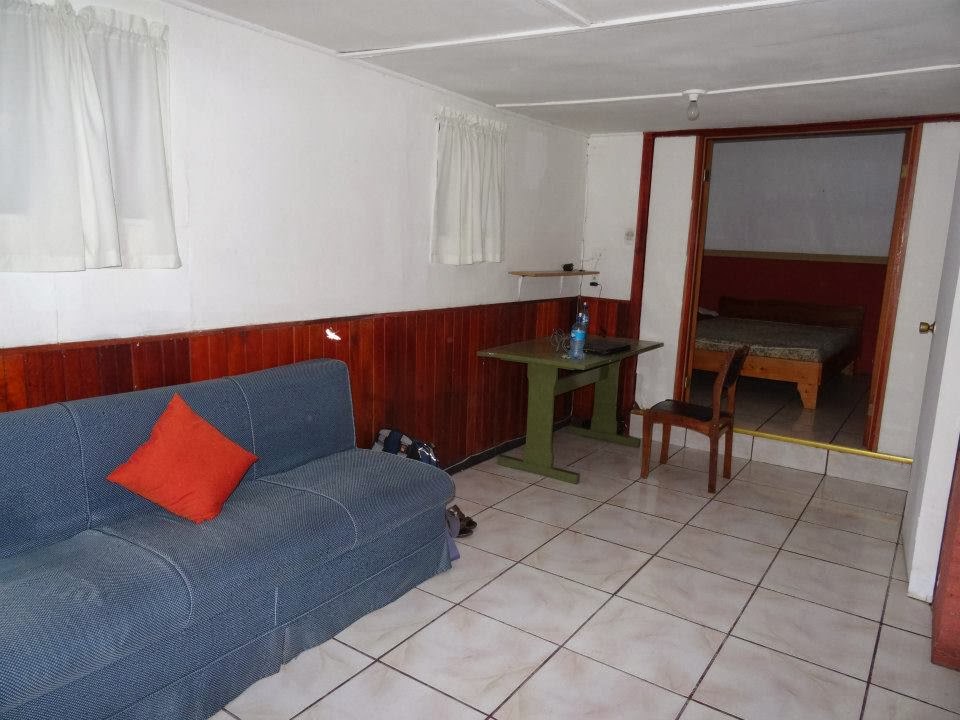
And now? How do I feel in my tiny 60m² apartment with no A/C and no TV and no table and no microwave and no screens in the windows? The one with the electric-wired "suicide shower" that only sometimes has hot water? My humble abode that I’ve decorated with bay leaves to keep the ants out?


I feel filled up with joy and contentment. It’s not the stuff, friends. It’s everything else. It’s sipping a hot buttered rum on a rickety little couch and laughing over language mishaps and sharing profound observations about life, the universe, and everything.

{42}

Perspective and priorities, folks. That’s where to find happiness.